Continuous flow vs storage hot water: which suits your home?
Both systems give you hot water at the tap, but they ask very different things of your house. Here’s how to match one to your household, your gas or power supply and the way you use hot water.
The short answer
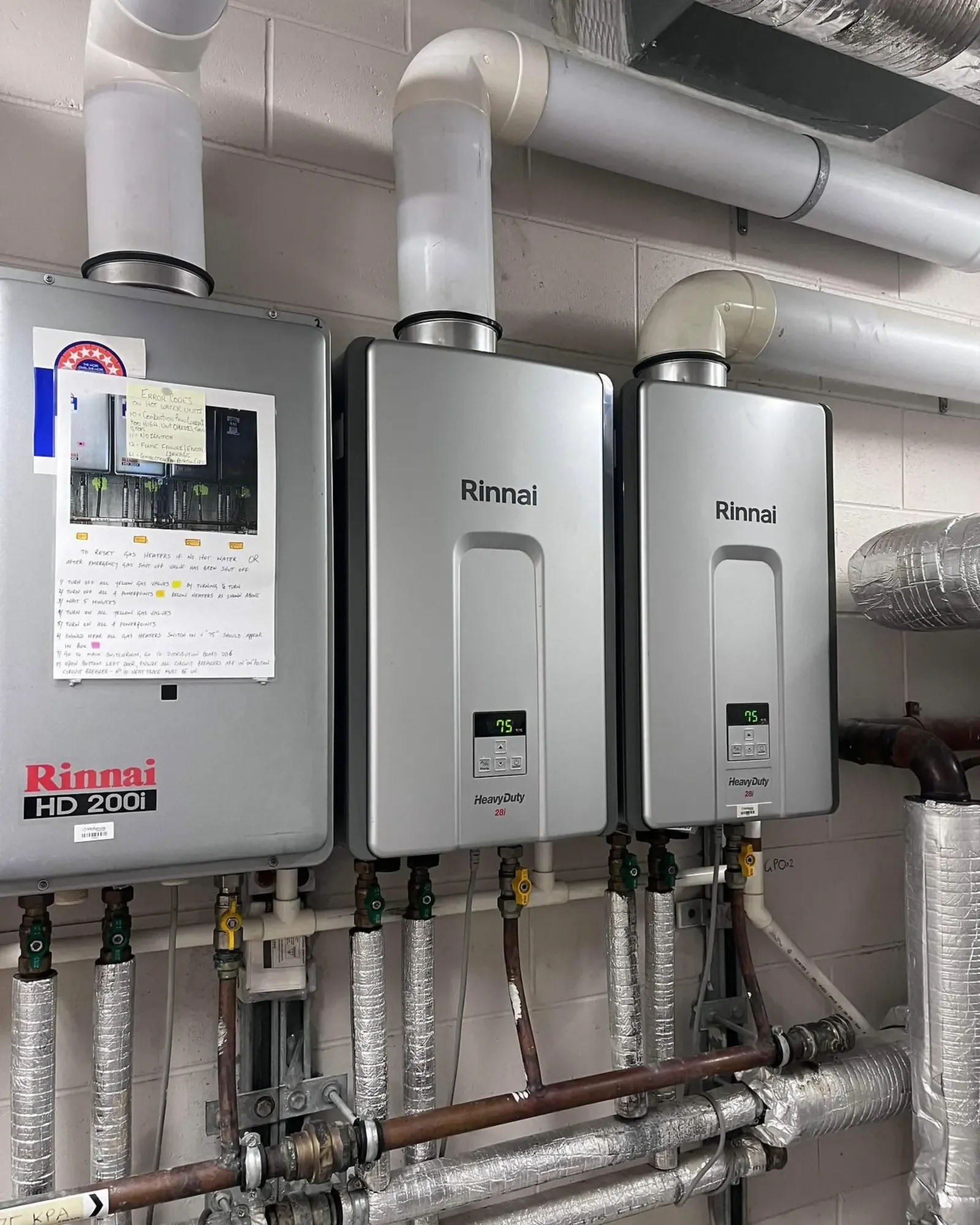
A continuous flow system heats water only as you use it, so it never runs out and has no tank losing heat. A storage system keeps a tank of hot water ready to be used. Continuous flow suits homes with a good gas supply or three-phase power. Storage suits off-peak tariffs and rooftop solar.
On this page
- How each system works, in plain terms
- Side by side: how the two systems compare
- Match your household and connections to a system type
- Gas, electric or LPG continuous flow: the supply capacity question
- What affects the running cost
- South-east Queensland factors: climate, gas availability and space
- Switching from storage to continuous flow, or back, needs a licensed plumber and gasfitter
- Getting it sized and installed: what to tell your plumber
- Frequently asked questions
How each system works, in plain terms
A storage system heats a tank of water and keeps it hot, while a continuous flow system heats water only as it passes through. The Australian Government’s Your Home guide explains that continuous flow (also called instantaneous) units have no storage tank, which makes them more compact, and because they heat water as it’s used they can’t run out.
In a gas continuous flow unit, opening a hot tap starts a burner that heats water as it flows through a coiled pipe called a heat exchanger, as the Energy Rating site describes. Electric continuous flow units use electricity to heat water on demand. Continuous flow is the most common type of gas water heater, according to energy.gov.au.
A storage tank works more like a kettle that stays on. Electric storage uses one or more elements in an insulated tank. Gas storage uses a burner under the tank. Heat pumps and solar systems are also storage systems, because they heat water into a tank and hold it there. The tank is the main difference: it stores energy for later, but it also slowly loses heat while it waits.
Side by side: how the two systems compare
The two systems trade off supply demands against heat loss, and neither suits every home. The table sets out the factors that usually decide the choice, drawn from Your Home, Energy Rating and manufacturer installation manuals.
| Factor | Continuous flow (instantaneous) | Storage tank |
|---|---|---|
| Running out | Can’t run out while gas or power is supplied | Can run out if the tank is too small for the household |
| Space | Compact unit with no tank; gas models outside, or inside with ventilation | Floor space for a tank, inside or outside |
| Heat loss | No storage loss, some heat-up and cool-down loss | Tank and pipe losses can be up to a third of energy use |
| Off-peak and solar | Electric units can’t be scheduled for off-peak or solar | Electric tanks over 250 litres suit off-peak; timers can use solar |
| Maintenance | Servicing interval set by the manufacturer | Glass-lined tanks have an anode replaced every few years |
Read the table by your own constraints first. A home with no mains gas and single-phase power has a shorter list of realistic options than a home with both.
Match your household and connections to a system type
The right type depends mostly on how many outlets run at the same time and what supply is already at the house. Count the hot outlets that genuinely run together on a busy morning, such as two showers and the dishwasher, then look at the row that fits. Ask your plumber to confirm the gas and electrical supply on site before quoting.
| Your situation | Usually worth considering | Check first |
|---|---|---|
| One or two people, mains gas, rarely two showers at once | Standard gas continuous flow | Gas pipe and meter size |
| Family of four or five, two or more showers at once, mains gas | High-performance gas continuous flow, or gas storage | Gas pipe and meter capacity for the larger unit |
| No mains gas in your street | LPG continuous flow, electric storage or heat pump | Room for two or more 45 kg bottles and a large gas pipe |
| Electric only, on an off-peak tariff | Electric storage over 250 litres, or a heat pump | Tank size against the hours of off-peak supply |
| Rooftop solar and someone home during the day | Heat pump or electric storage on a timer | Whether the unit has a built-in timer |
| Small unit or apartment with three-phase power | Electric continuous flow | Switchboard capacity, with a licensed electrician |
For a family of five, the outlet count matters more than the head count. Your Home notes that standard gas units supply only one or two outlets at once, while high-performance units can supply three or more. If two showers and a washing machine regularly overlap, size for that, not for the average day.
Gas, electric or LPG continuous flow: the supply capacity question
Continuous flow units draw a lot of power, or a high gas flow, while they run.
Electric continuous flow is the hardest case. Your Home says electric instantaneous units can draw up to 28 kilowatts when operating, a load that requires a three-phase connection, which not all homes have. Energy Rating adds that in some cases single phase power is adequate, but Your Home notes single-phase units have very limited flow rates, making them suitable only for basins and not showers. Rinnai’s installation manual for its electric continuous flow range lists a 415V three-phase supply and says installation needs an electrician and a plumber. Queensland’s Electrical Safety Office says hard-wired appliances must be connected by a licensed electrician.
Gas continuous flow needs a high gas flow instead. Your Home warns this may mean larger gas pipes or a bigger meter, and that an existing stove line may need replacing for an LPG unit. Rinnai’s gas continuous flow manual says pipe sizing must allow for the water heater plus every other gas appliance in the home, and the meter and regulator must suit that gas rate. That Rinnai gas model also needs an earthed power point beside it.
What affects the running cost
Running cost comes down to how the water is heated, when it’s heated and how much heat is lost along the way. No single type is always the cheaper one to run, so look at these drivers for your own home rather than a national average.
- Standing heat loss: Your Home says heat lost from storage tanks, fittings and pipes can be up to one third of a storage system’s energy use. Continuous flow avoids that loss, though small, frequent uses still waste some heat warming up and cooling down.
- Gas storage insulation: energy.gov.au notes gas storage tanks lose a lot of heat because the tank can’t be insulated where the flame heats it. Your Home says instantaneous gas generally uses less energy than gas storage.
- Your electricity tariff: electric storage tanks over 250 litres can heat during off-peak periods. Your Home says electric instantaneous units are often more expensive to run than storage because they can’t be scheduled for off-peak or solar.
- Rooftop solar: with a large solar PV system, an electric tank or heat pump can be set to heat on your excess daytime solar, often with a built-in timer.
- Gas type: Your Home says natural gas and LPG systems have similar efficiencies, but LPG systems are around two to three times more expensive to run.
- How you use it: Your Home says most household hot water is used for showers and baths.
South-east Queensland factors: climate, gas availability and space
South-east Queensland’s warm climate, patchy mains gas and outdoor installations each shape the choice. Your Home notes that some instantaneous gas units behave erratically at low flow rates when the inlet water is already warm, as in warm climates or when solar preheats it. A low-flow showerhead can make that worse, so check it’s compatible with the unit.
Gas availability varies by street. The Queensland Government says not all Queensland homes have mains natural gas, and you can check for a pipeline in your street on 1300 001 001 or through Energy Made Easy. Business Queensland lists Allgas, part of the APA Group, as the distributor for Brisbane’s southern suburbs. Where there’s no main, LPG bottles are the gas option.
Space usually favours continuous flow, which Your Home says is more compact than storage. Gas models can mount outside, or inside only with suitable ventilation. For suburb-specific advice, see our pages on solar hot water in Victoria Point and economy tariffs in Capalaba.
Switching from storage to continuous flow, or back, needs a licensed plumber and gasfitter
Changing system type is regulated work in Queensland, not a like-for-like swap. The Queensland Government lists installing or replacing a hot water heater as notifiable work, which a licensed plumber does and then registers. The QBCC includes installing, replacing or removing a water heater in its categories of notifiable work. The plumbing jobs an owner may do personally are a short list, such as changing a shower head or a tap washer.
A switch often touches several trades. The gas side may need a new or larger pipe, a meter upgrade or a conversion between natural gas and LPG, and the Queensland Government says only a licensed gasfitter can do gas work, including pipework and connections. The electrical side may need a three-phase connection, and hard-wired appliances must be connected by a licensed electrician. On the water side, Business Queensland says every new and replacement system needs a temperature control device so taps deliver no more than 50°C, while storage tanks must heat to at least 60°C to control Legionella. Our guide to tempering valves and TMVs explains the difference.
Getting it sized and installed: what to tell your plumber
A plumber can size a system properly once you give them a few facts about the house and how you use hot water. You can gather most of them yourself by looking, counting and taking photos, without opening anything up.
- How many people live in the house, and how many hot outlets run at the same time on a busy morning.
- Whether you have mains gas, LPG bottles or no gas, and a photo of the gas meter or bottles if you have them.
- A photo of the old unit’s data plate.
- Your power bill, to see whether the hot water is on a separate off-peak tariff.
- Whether you have rooftop solar, and whether anyone is home during the day.
- A photo of the switchboard, so an electrician can judge the supply if electric continuous flow is on the table.
Jim Monger Plumbing and Gas handles hot water repairs, replacements and new installations across gas, electric and heat pump units, takes the old unit away and lodges the QBCC Form 4 for a new water heater. We hold QBCC licence 15504687 and gas licence L90908. See our hot water service across Brisbane and the Redlands, or read the hot water system buying guide to compare heat pump and solar options too. If your current tank is dripping, start with what to do when a hot water system leaks. To talk it through, call 0418 871 269.
Frequently asked questions
Can continuous flow hot water run out?
No, not while the gas or power supply keeps up. A continuous flow unit heats water as it passes through, so there’s no tank to empty. What it can do is fall short when too many outlets run at once: a standard gas unit handles one or two outlets, so a third shower may run cooler. Sizing for your busiest morning avoids that.
Why does continuous flow sometimes take a moment to get hot, or go cold briefly?
Hot water left in the pipe between the unit and the tap goes cold, so it has to clear first. Some units also need a minimum flow before they start heating: Rinnai’s electric model, for example, starts heating at 2.5 litres a minute. A tap barely open, a very low-flow showerhead or warm inlet water can make some gas units cut in and out.
Do continuous flow and storage systems need regular servicing?
Yes, on the schedule in the manufacturer’s manual. Rinnai, for example, recommends servicing one of its domestic gas continuous flow models every three years and its electric continuous flow unit every 12 months. Glass-lined storage tanks have a sacrificial anode that Your Home says needs replacing every few years. The Queensland Government says gas appliances should be serviced periodically by a licensed gasfitter.
Can I run a continuous flow unit off LPG bottles?
Yes. Your Home says LPG systems generally need two or more 45 kg bottles so you aren’t swapping them constantly, and instantaneous LPG units need a large gas supply pipe. Appliances need the right burner for the gas type, and any installation or conversion must be done by a licensed gasfitter.
Does a continuous flow system work with rooftop solar?
Not well if it’s electric. An electric continuous flow unit heats the moment you open the tap, so it can’t wait for the sun, and Your Home says that’s why these units are often dearer to run than storage. If you have solar, an electric tank or heat pump with a timer can heat during the day on your own power.
Is it better to keep hot water on continuous or timed?
For an electric tank, a timer or controlled load can shift heating to cheaper or solar hours, and Your Home suggests a timer may suit homes with solar. Set it so the tank still reaches its Legionella-control temperature. Queensland Health advises not to turn hot water systems down, and not to turn them off unnecessarily. A continuous flow unit heats on demand, so a timer doesn’t apply.
Where to next
- Read next: Choosing a hot water system
- Need it fixed: Hot water systems, or call 0418 871 269
Sources
- Hot water systems, Your Home, Australian Government. Accessed 28 October 2026.
- Hot water systems, energy.gov.au, Australian Government. Accessed 28 October 2026.
- Water heaters, Energy Rating, Australian Government. Accessed 28 October 2026.
- Hot water systems, Business Queensland. Accessed 28 October 2026.
- Plumbing laws, Queensland Government. Accessed 28 October 2026.
- Categories of notifiable work, Queensland Building and Construction Commission. Accessed 28 October 2026.
- Using natural gas and LPG safely, Queensland Government. Accessed 28 October 2026.
- Compare and choose gas retailers, Queensland Government. Accessed 28 October 2026.
- Your gas supply, Business Queensland. Accessed 28 October 2026.
- Don’t do your own electrical work, Electrical Safety Office, Queensland Government. Accessed 28 October 2026.
- Legionnaires’ disease prevention, Queensland Government. Accessed 28 October 2026.
- Gas continuous flow water heater operation and installation manual (Infinity Enviro 32), Rinnai Australia. Accessed 28 October 2026.
- Electric continuous flow water heater operation and installation manual, Rinnai Australia. Accessed 28 October 2026.