
Choosing a hot water system for a south-east Queensland home: gas, electric, heat pump or solar
There is no single right answer, but there is a right answer for your house. This guide compares the five main system types side by side, so you can brief a plumber with confidence instead of guessing.
The short answer
The right hot water system depends on four things: how many people use hot water and when, whether you have piped gas, LPG or only electricity, how much roof and side space you have, and whether you have rooftop solar. The Australian Government's Your Home guide rates heat pump and solar systems as the most efficient. In a warm, humid climate like south-east Queensland, a heat pump is often worth a close look.
On this page
- The five main hot water system types in plain terms
- How gas, electric, heat pump and solar compare
- Which system suits your household and site
- South-east Queensland conditions favour heat pumps and solar
- Sizing: matching the tank or flow rate to your household
- What affects the size of the job and the running cost
- Repair or replace? Check in this order
- Queensland rules: licensed installation, tempering valves and incentives
- What to tell your plumber before you get a quote
- Frequently asked questions
The five main hot water system types in plain terms
Almost every home hot water system falls into one of five types: gas storage, gas or LPG continuous flow, electric storage, heat pump and solar. Storage systems keep a tank of water hot and ready. Continuous flow (also called instantaneous) systems heat water only as you use it, so Your Home notes they cannot run out.
- Electric storage: an element heats the water in the tank, like a giant kettle. Simple, but much less efficient than a heat pump.
- Gas storage: a burner under the tank heats the water. It reheats faster than electric, so the tank can be smaller.
- Gas or LPG continuous flow: a unit, usually installed outdoors, that heats water as it is used.
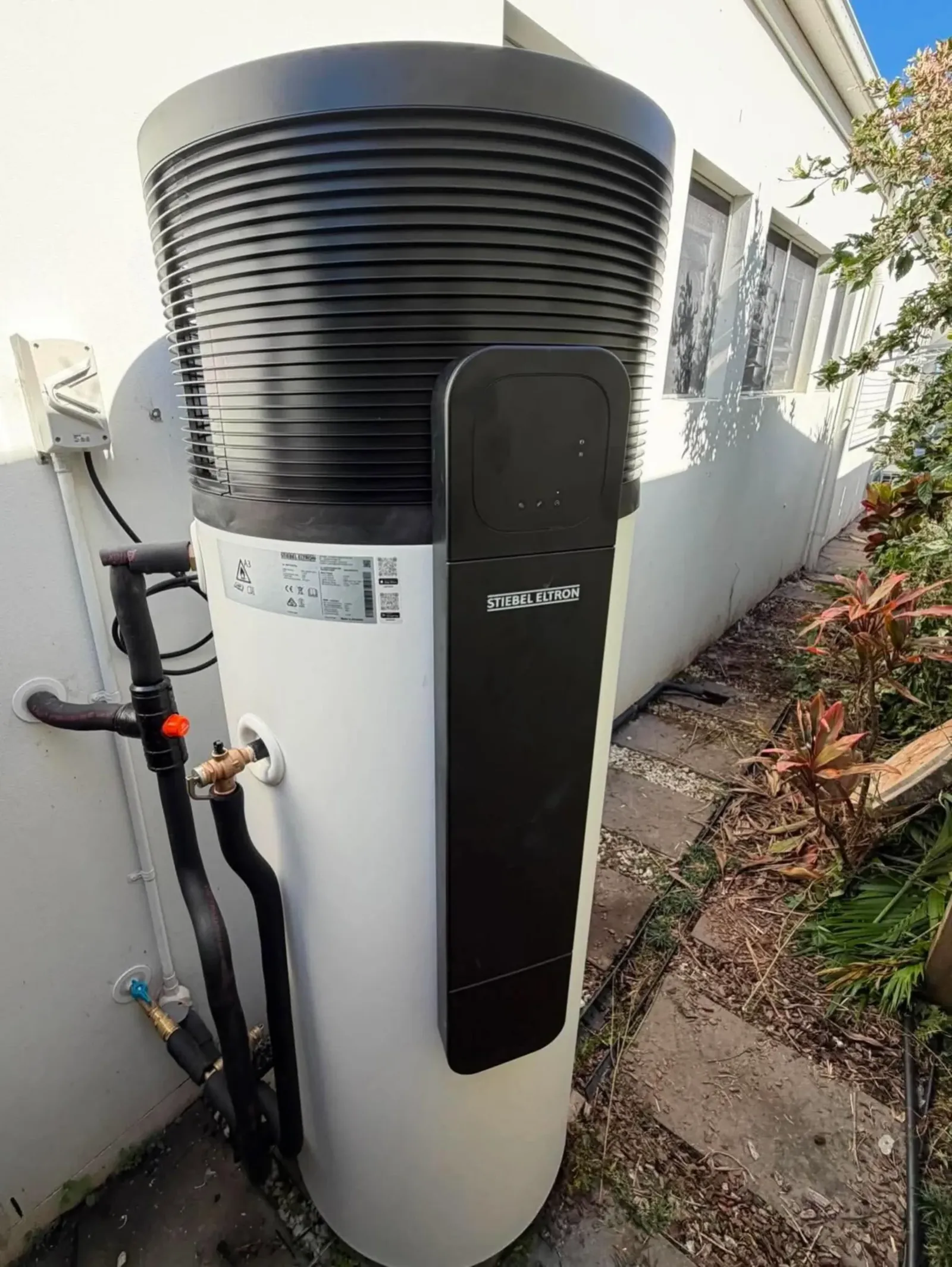
- Heat pump: an electric system that pulls heat from the surrounding air to heat the water in a storage tank.
- Solar: collectors on the roof heat the water, with a gas or electric booster for cloudy days and heavy use.
Heat pumps come as integrated units, with the compressor sitting on top of the tank, or as split systems, with a separate low outdoor unit. Your Home says an integrated heat pump can be a straightforward swap for an existing electric storage tank.
How gas, electric, heat pump and solar compare
Heat pump and solar hot water systems are much more efficient than other options and usually have the lowest energy use. Your Home puts a heat pump's coefficient of performance at around 3 to 5, against roughly 0.95 for new electric storage and 0.75 to 0.96 for gas. energy.gov.au says a heat pump uses 30% of the energy of a conventional electric system. Efficiency is only one factor, so the table below also shows what each type needs from your site.
| System | How it heats | Can it run out? | What it needs on site | Watch out for |
|---|---|---|---|---|
| Electric storage | Element inside a tank | Yes, if the tank is too small | Space for the tank; a tank over 250 litres to suit off-peak tariffs | Much less efficient than a heat pump |
| Gas storage | Burner under the tank | Yes, but reheats faster than electric | Piped gas or LPG bottles, outdoor venting | Rated by energy.gov.au as particularly inefficient |
| Gas or LPG continuous flow | Burner heats water as it flows | No | Enough gas supply; sometimes a bigger gas pipe or meter | Standard units suit one or two outlets at once |
| Heat pump | Pulls heat from the air into a tank | Yes, if the tank is too small | Outdoor spot away from neighbours and nearby windows | Compressor noise; boost element use in cold snaps |
| Solar | Roof collectors plus a booster | Yes, if the tank is too small | Unshaded north-facing roof space | Booster use if you mostly shower in the morning |
energy.gov.au notes that gas hot water heaters are usually installed outdoors because of venting requirements, so plan the spot as well as the system type.
Which system suits your household and site
The system that suits your home is the one that matches your existing connections, your space and the way your household uses hot water. Use the table below as a starting point for the conversation with your plumber, not a final answer. A household that showers one after another in the morning has different needs from two people spread across the day.
| Your situation | Systems to look at first | Check before you decide |
|---|---|---|
| Existing electric storage tank, no gas | Heat pump or a new electric storage tank | Noise placement, and whether the heat pump suits your tariff |
| Large rooftop solar PV system already installed | Heat pump or electric storage on a timer | That the unit has a timer or app control to heat during the day |
| Piped gas at the street and a busy household | Gas continuous flow or a heat pump | How many showers run at once, and the gas pipe size |
| No piped gas, prefer gas | LPG continuous flow | Room for at least two 45 kg bottles and delivery access |
| Good unshaded north-facing roof | Solar, or a heat pump with solar panels | Roof condition, shading and booster type |
| Small block, bedrooms close to the fence | Split heat pump, gas continuous flow or electric storage | Where the noisy part of a heat pump would sit |
If your existing system uses gas, Your Home suggests considering how you could replace it with an efficient electric system to reduce running costs and greenhouse gas emissions. That is a choice to make with your plumber, based on your house.
South-east Queensland conditions favour heat pumps and solar
The warm, humid climate of the Redlands, Logan and south-east Brisbane suits heat pumps and solar better than colder parts of Australia. Your Home says air-source heat pumps suit relatively warm, humid climates, and that sunny locations let solar systems work most effectively. energy.gov.au notes that not every heat pump is designed for places that regularly drop below 5°C in winter, so check the rating of any model you are considering.
Gas is a different story. Your Home notes that piped gas is not available in many areas, so check your street before you plan on a gas system. Without piped gas, the gas option is LPG, which Your Home says generally needs two or more 45 kg bottles and costs more to run than piped gas for a similar efficiency.
Siting matters on smaller suburban blocks. A heat pump compressor can be about as noisy as an air conditioner, and on an integrated unit the noisy part sits high up, so the sound can carry over fences. A split system keeps the outdoor unit low, and Your Home says the distance between the two units is usually limited to 10 to 15 metres.
Sizing: matching the tank or flow rate to your household
Size a hot water system to the people living in the house now and how they use hot water, not to the old unit. Your Home says one person typically uses about 50 litres of hot water a day, and asks you to check your own habits before deciding.
- Too small: the tank runs out, especially when visitors stay or everyone showers in the same hour.
- Too big: you pay to keep water hot that nobody uses. Your Home says a larger tank uses more energy keeping the water hot.
- Off-peak electric: Your Home says electric storage tanks larger than 250 litres can be set to heat during off-peak periods, and smaller ones are unsuitable for it. Check the tank size if you want off-peak heating.
- Continuous flow: think in outlets, not litres. Your Home says standard gas units suit only one or two outlets at once, while high-performance units can supply three or more.
Queensland homes on a controlled load have limited heating hours. Your Home says Tariff 31 may provide power for 6 to 10 hours a day and Tariff 33 about 16 to 18 hours. Some heat pumps are not compatible with either, and others only work with Tariff 33, so check the manual for the model you are considering. For more on tank versus tankless, read our guide to continuous flow vs storage hot water.
What affects the size of the job and the running cost
A like-for-like swap is usually the simplest replacement, and a change of fuel or system type adds work. Your Home notes that an integrated heat pump connects in the same way as a standard electric tank. Moving from electric to gas, or from gas to a heat pump, can mean new gas pipework or a new spot for the unit.
- Access: where the old unit sits, how far the new one is from the bathroom, and how easy it is to get a tank in and out.
- Gas supply: Your Home says continuous flow units can need larger gas pipes or meters.
- Electrical: electric continuous flow usually needs a three-phase connection, which not every home has.
- Tariff: whether the system can run on a controlled load or a timer.
- Solar panels: Your Home says many newer heat pumps have timer or app control to use excess power from your own solar system, and an electric hot water system can be configured to do the same if you have a large solar PV system.
Your Home says heat pump and solar systems usually have the lowest energy use. A heat pump's boost element can lift running costs if it cuts in often, and heating in the warmer afternoon can reduce a heat pump's energy use.
Repair or replace? Check in this order
Your Home advises thinking about your options before your existing system fails, because you may not have much time to decide once it does. These safe checks help your plumber diagnose the problem faster.
- Look for water around the base of the tank or unit. If water is leaking from the tank itself, turn off the cold water isolation valve at the unit and call a plumber.
- Look at the relief valve drain pipe. Your Home says that if a bucket placed under the relief valve fills in a day, the valve needs replacing. That replacement is a plumber's job.
- Note whether a hot water breaker has tripped at the switchboard, or whether a gas unit shows an error code. Photograph it for your plumber.
- Find the label or compliance plate on the unit and photograph it, so your plumber knows the model, size and age.
- Think about whether the system has kept up with the household. If you run out often, a different size or type may be the better fix.
If the hot water has simply stopped, work through our no hot water troubleshooting guide first. If the tank is dripping, see what to do about a leaking hot water system.
Queensland rules: licensed installation, tempering valves and incentives
In Queensland, installing or replacing a hot water system is licensed plumbing work, and any gas work needs a gas work licence or authorisation. The Queensland Government's plumbing laws page lists installing or replacing hot water heaters, including electric, solar and heat pump units, as notifiable work for a plumber. The short list of jobs owners may do themselves covers tasks like changing a shower head or a tap washer. Business Queensland says you need a licence or authorisation before doing any gas work, and the QBCC has a separate endorsement for installing and replacing solar and heat pump systems.
Your Home says new hot water systems need a tempering valve or other method so tap water does not exceed 50°C, while storage water must reach at least 60°C once every 7 days to control Legionella. Water at 60°C can burn skin within 5 seconds. Our guide to tempering valves and TMVs explains the difference.
For incentives, federal support for heat pump and solar systems comes through Small-scale Technology Certificates, administered by the Clean Energy Regulator. Your Home says STCs will be phased out by the end of 2030. Check current state and federal programs on the energy.gov.au rebates finder.
What to tell your plumber before you get a quote
Give your plumber the details below and you will get a quote that matches your house the first time. A clear brief also makes it easier to compare quotes on the same system type and size.
- How many people live in the house, and when most of the showers happen.
- Photos of the old unit, its label, and the space around it.
- Whether you have piped gas, LPG bottles, or electricity only.
- Whether you have rooftop solar panels, and which electricity tariff the hot water is on.
- Any noise concerns, such as bedrooms or a neighbour's window near the unit.
- Whether you are open to changing system type, or want a like-for-like swap.
Jim Monger Plumbing and Gas carries out repairs, replacements and new installations across gas, electric and heat pump units, with the old unit removed as part of a replacement. See our hot water systems service, or our page for hot water in Victoria Point and nearby suburbs. Call 0418 871 269. QBCC licence 15504687, gas licence L90908.
Frequently asked questions
Can I switch from gas to a heat pump, or electric to gas?
Yes, a change of system type is possible, but it adds work compared with a like-for-like swap. Going to gas needs a gas supply and a licensed gasfitter. Going to a heat pump needs a suitable outdoor spot. Your Home notes that some electric storage tanks can be paired with a split heat pump or solar unit, so ask your plumber whether your tank qualifies.
Is a heat pump noisy, and where should it go?
energy.gov.au compares heat pump compressor noise to an air conditioner. On an integrated model the noisy part sits high up, so the sound can carry over fences to neighbours or nearby windows. A split system with a low outdoor unit gives you more freedom, because the tank and outdoor unit can usually sit up to 10 to 15 metres apart.
Do gas hot water systems need servicing?
Yes. Gas storage tanks with a glass lining have a sacrificial anode that Your Home says needs replacing every few years, and the relief valve should be watched for constant dripping. Servicing a gas appliance counts as gas work in Queensland, so it needs a licensed gasfitter rather than a handyman.
Are there rebates for heat pump or solar hot water in Queensland?
Federal Small-scale Technology Certificates apply to eligible heat pump and solar systems, and Your Home says STC discounts are often already included in the advertised installed price of a heat pump system. The Clean Energy Regulator says assigning your certificates to a registered agent may give you an upfront discount. For current state programs, search the energy.gov.au rebates finder, as programs change over time.
How long does a hot water system usually last?
There is no fixed number. As a guide, Your Home puts tank warranties at typically 5 to 10 years for glass-lined steel and 10 to 15 years for stainless steel. A warranty is not a lifespan, but it shows how long the maker backs the tank. Replacing the anode on time helps a glass-lined tank last.
Can my hot water system run off my rooftop solar panels?
Often, yes. Your Home says many newer heat pumps have timers or app control so they heat while your panels are generating, and if you have a large solar PV system, an electric hot water system can be configured to use your excess solar. Your Home also notes that a heat pump running on solar panels gives many of the same benefits as a solar hot water system. Check that the model you choose has a built-in timer.
Will a heat pump work in very hot weather?
Your Home says air-source heat pumps work best in relatively warm, humid climates, and that efficiency drops in colder climates as the refrigerant is less able to absorb heat. It does not give a maximum temperature, so ask your plumber or the manufacturer about very hot conditions for the model you are considering.
Where to next
- Read next: Continuous flow vs storage hot water
- Need it fixed: Hot Water Systems, or call 0418 871 269
Sources
- Hot water systems, Your Home, Australian Government. Accessed 28 October 2026.
- Hot water systems, energy.gov.au, Department of Climate Change, Energy, the Environment and Water. Accessed 28 October 2026.
- Rebates and assistance, energy.gov.au, Department of Climate Change, Energy, the Environment and Water. Accessed 28 October 2026.
- Plumbing laws, Queensland Government. Accessed 28 October 2026.
- Apply for a new gas work licence or authorisation, Business Queensland. Accessed 28 October 2026.
- Plumber and drainer endorsements, Queensland Building and Construction Commission. Accessed 28 October 2026.
- Small-scale technology certificates, Clean Energy Regulator. Accessed 28 October 2026.